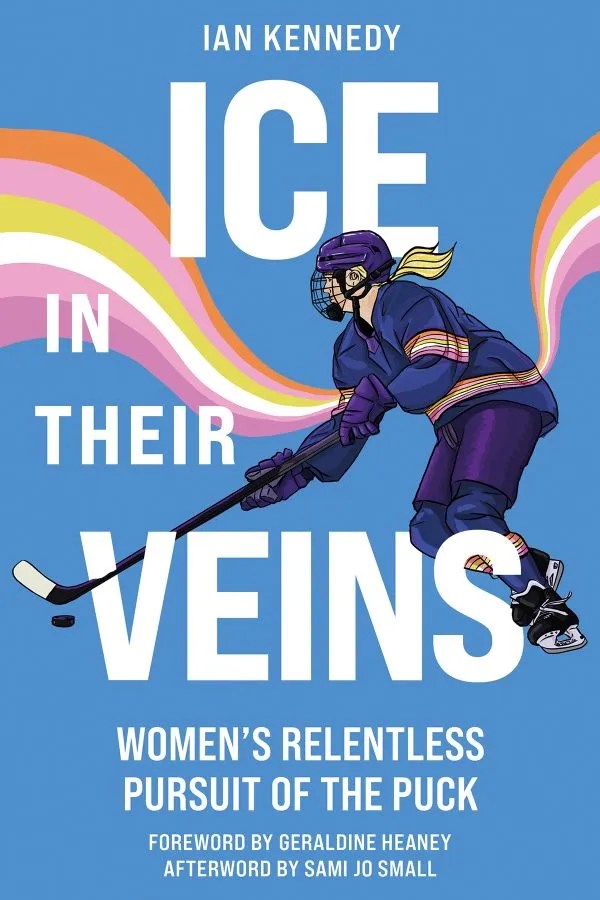
Photo from https://www.tidewaterpress.ca/ice-in-their-veins/
Ian Kennedy’s Ice in Their Veins: Women’s Relentless Pursuit of the Puck is an important update to women’s (stand-up) hockey history books. Unfortunately, but perhaps unsurprisingly, there are very few books on women’s hockey or its histories, and several of them are out of print. Here is a list, for those wanting to read more about women’s stand-up hockey history: Brian McFarlane’s Proud Past, Bright Future: One Hundred Years of Canadian Women’s Hockey (1994), Elizabeth Etue and Megan K. Williams’s On the Edge: Women Making Hockey History (1996), Joanna Avery and Julie Stevens’s Too Many Men on the Ice: Women’s Hockey in North America (1997), Lynda Baril’s Nos Glorieuses: Plus de Cent Ans de Hockey Feminin au Quebec (2013), and Wayne Norton’s Women on Ice: The Early Years of Women’s Hockey in Western Canada (2017).1 These are significant texts that have done important work in establishing the field and documenting the written histories of women’s hockey. At the same time, there has not been a book that focuses on the history of women’s stand-up hockey (as a whole rather than a specific period or place) since the late 1990s.2 Women’s stand-up hockey has rapidly increased in popularity and visibility since the nineties, and Ice in Their Veins is an important addition to books on women’s stand-up hockey.
For those new to women’s hockey journalism, Ian Kennedy is one of the main and most popular journalists covering professional women’s hockey in Canada and the United States—along with others such as Hailey Salvian at The Athletic and the writers at The Victory Press, to name a few. Ice in Their Veins: Women’s Relentless Pursuit of the Puck is in many ways a culmination of Kennedy’s work that builds on his relationships and reputation with elite level women’s hockey.
The quotes and stories from women’s stand-up hockey players, coaches, and organizers add a richness to this book that will make it an important resource for those reading in the present as well as the future. Kennedy, who lists an impressive group of people he talked to in the acknowledgements, conducted fantastic research and brought up a lot of people and events that will be new information for many fans of women’s stand-up hockey. It is fascinating to read about women’s stand-up hockey history from those who lived it and to hear their stories in their own words, and this book contains several new and significant interviews that fill in some of the gaps of women’s stand-up hockey history. For instance, it was really interesting to hear Kelly Dyer describe her involvement in the development of women specific hockey equipment, Justine Blainey provide more details on her fight to play boys hockey in the eighties, Bev Beaver talk about her hockey career, Fran Rider talk about some of the behind the scenes action in organizing women and girls hockey in Ontario (and the World Women’s Hockey Tournament), and Tamae Satsu discuss women’s stand-up hockey in Japan. There are several other important interviews throughout the book, particularly in the second half. Another highlight of the book is hearing more about women’s hockey in countries other than Canada, the United States, and Europe, and it was great to hear more about the women’s game in places like Australia and Japan. Another highlight of the book are the sections on professional women’s hockey leagues from the 2000s onwards; again, these sections will be an important resource since most women’s hockey history books were published before these leagues were formed. Kennedy talks to several of the key figures of these leagues, and they provide illuminating insights about what happened behind the scenes during this critical period in women’s stand-up hockey history.
I suspect that one of the most divisive parts of Ice in Their Veins will be Kennedy’s insertion of himself into a book about women’s stand-up hockey history. The book’s introduction and most of the opening section of the chapters (usually around one to two pages) are about Kennedy and his relationship to hockey. Some will read Kennedy’s decision as a useful attempt to situate his positioning, thereby more directly convening his biases, while others, I think, will read Kennedy’s insertion as unnecessary. The introduction, where Kennedy describes his own hockey history and how he became interested and involved in girls and women’s stand-up hockey, is useful; however, the brief chapter introductions are a bit distracting and sometimes feel out of place. What Kennedy writes in the opening of most chapters, particularly how he was taught a restrictive view of masculinity from a patriarchal hockey system and how he had to unlearn these problematic views, is valuable, but these brief reflective sections would be better situated in an introduction or conclusion. Lastly, I wish this book discussed women’s para hockey history, but unfortunately, the women’s sport is not even mentioned, and this is a significant omission. The subtitle of this book is “Women’s Relentless Pursuit of the Puck,” and stand-up women’s hockey players are not the only ones to pursue a puck.3
This book continues Kennedy’s work of highlighting and advocating for women’s hockey (and I would encourage readers to follow The Hockey News’ “Women’s Hockey” page that Kennedy started), and Ice in Their Veins is an impressive and important book. It is a valuable resource for those new to women’s stand-up hockey and includes quite a few new details and anecdotes for veteran women’s stand-up hockey fans. With the publication of Kennedy’s Ice in their Veins and R. Renee Hess’s incredibly significant and brilliant Blackness Is a Gift I Can Give Her: On Race, Community, and Black Women in Hockey within two weeks of one another and Karissa Donkin’s forthcoming Breakaway (Donkin is another key hockey journalist, and this book is set to be released in Fall 2025), I hope we are beginning to see a resurgence of non-fiction books on women’s hockey.
Ian Kennedy’s Ice in Their Veins can be purchased at the Tidewater Press website
Endnotes
1 There are also a few children’s and young adult books on women’s hockey like Carly Adams’s Queens of the Ice: They were fast, they were fierce, they were teenage girls (2011). Additionally, there are other hockey and sport history books that include sections on women’s stand-up hockey history.
2 Baril’s book is on women’s stand-up hockey in Quebec while Norton’s book is on the women’s game in Western Canada in the early twentieth century.
3 It is important to note that Kennedy has written several important articles on the Women’s Para Hockey of Canada team, and he is one the few hockey journalists who writes on women’s para hockey. It would have been helpful if this book included a brief explanation, or qualifier, that explicitly stated that this book was on stand-up women’s hockey history.
Works Cited
Adams, Carly. Queens of the Ice: They were fast, they were fierce, they were teenage girls. James Lorimer & Company, Ltd., Publishers, 2011.
Avery, Joanna, and Julie Stevens. Too Many Men on the Ice: Women’s Hockey in North America. Polestar Book Publishers, 1997.
Baril, Lynda. Nos Glorieuses: Plus de Cent Ans de Hockey Feminin au Quebec. Les Editions La Presse, 2013.
Etue, Elizabeth, and Megan K. Williams. On the Edge: Women Making Hockey History. Second Story Press, 1996.
Hess, R. Renee. Blackness Is a Gift I Can Give Her: On Race, Community, and Black Women in Hockey. McClelland & Stewart, 2024.
Kennedy, Ian. Ice in Their Veins: Women’s Relentless Pursuit of the Puck. Tidewater Press, 2024.
McFarlane, Brian. Proud Past, Bright Future: One Hundred Years of Canadian Women’s Hockey. Stoddart Publishing, 1994.
Norton, Wayne. Women on Ice: The Early Years of Women’s Hockey in Western Canada. Ronsdale Press, 2017.
 Hockey in Society / Hockey dans la société
In my view, Ice in Their Veins: Women relentless pursuit of the Puck by Ian Kennedy is a very significant book about women in hockey history. Books on women in hockey are not abundant to start with and most of the books that exist were published in the 1990s, so this seems like a very welcome refresh. My favorite part is that Kennedy incorporates numerous voices of the game players, coaches, and organizers such as Kelly Dyer, Justine Blainey, Fran Rider, Bev Beaver, and Tamae Satsu. Their tales not only make the history alive but also make us aware of women hockey in such areas where we do not commonly hear of such as in Japan and Australia. I also found the chapters about professional women leagues of the 2000s to be of great value, as the older books do not discuss the same. Sometimes I found personal thoughts of Kennedy distracting, and I would have preferred him to include para hockey of women, but on the whole, this book is a great and highly valuable resource.